


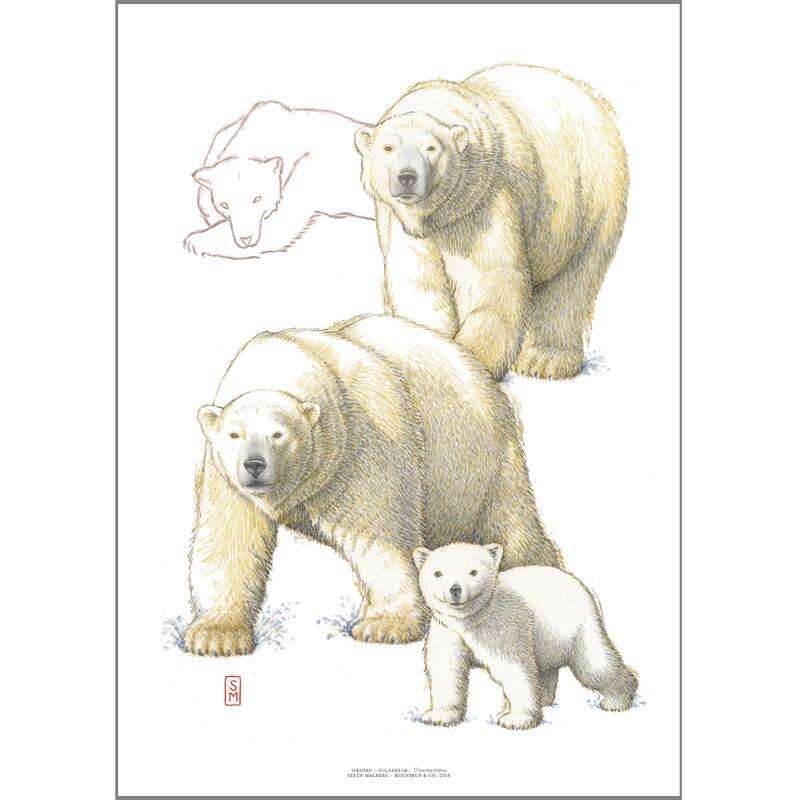


ART PRINT A3 - ZOO Polar Bear
Polar bear, Ursus maritimus, illustrated by Steen Malberg.
Printed on matte, thick, environmentally certified FSC paper.
Packed in an eco-friendly cellophane sleeve.
Measures 29.7 x 42 cm.
Polar bear, Ursus maritimus, is a large yellowish-white bear with a body length of up to 2.8 meters that lives around the North Pole. The polar bear is the largest living bear species, weighing around 700 kg. Standing on its hind legs it can reach 3–4 meters in height. It is larger and longer, has a narrower head and a longer neck than other bears.
What’s particularly characteristic about the polar bear is its insulating fur, which consists of a layer of underfur and a layer of guard hairs. The undercoat is dark and the hairs are translucent, which helps the polar bear absorb heat especially well.
The polar bear’s primary diet consists of beluga whales, walruses, lemmings, seals, fish and, in fact, any source of meat. When hunting, it uses its large claws and sharp canines, which are bigger than those of other bears, and its molars are sharper and more serrated. Its sense of smell and its curiosity to investigate and explore are also indispensable to the polar bear.
Apart from mating season and raising young, the polar bear mostly lives alone. It is active both day and night. The white bear is a good swimmer but can also move quickly on land, reaching speeds of around 55 km/h.
The polar bear reaches sexual maturity after 3–4 years and typically mates in March–May, though only every third year. The female is pregnant for 7–8 months and typically gives birth to two cubs. The cubs are blind for the first 30 days but can fend for themselves after 2–3 years.
Outside captivity, the polar bear typically lives between 25 and 30 years.
Spring is the most important time for the polar bear, when it takes in 75–85% of the energy it will live off for the rest of the year.
The polar bear is a threatened species in the sense that it is hunted for its meat and fur. In addition, climate change contributes to the polar bear’s declining population, since the bear depends on hunting seals that live on ice-covered areas — without ice there is no food.
All art prints in the zoo series are also available in A4
