


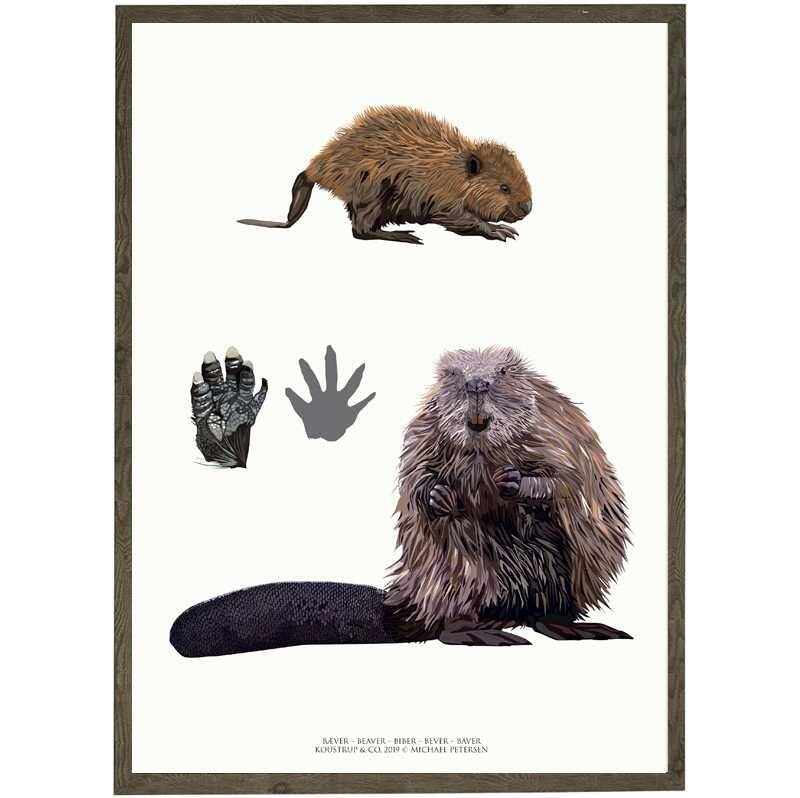
Beaver - ART PRINT - CHOOSE SIZE
Beautiful art print featuring a beaver motif. Illustrated by illustrator Michael Petersen.
Printed on matte, heavy-quality paper from our own printer.
Sizes B2 and A2 are delivered rolled with tissue paper inside a triangular cardboard tube with an attractive silver print. A4 and A3 are single-packed and delivered flat in a biodegradable cellophane bag.
Exclusive frame - available for purchase.
The beaver lives where there is access to fresh water, and is also found by lakes and streams. Its diet consists entirely of plants. Bark from deciduous trees is the primary food source in winter, while leaves, shoots, buds and small twigs are on the menu in summer.
Beavers are active at night, with their busiest hours from sunset until early morning. However, beavers can be active during the day too, but only in completely undisturbed areas.
In autumn the beaver fells trees to stock up for winter. It does this with its ever-growing front teeth, which wear down as they are used. The animal does not hibernate, but its activity level is significantly reduced.
A beaver's lodge is made of twigs, branches and mud. The lodge is always covered by water to prevent predators from entering. If the water level in front of the lodge is low, the beaver quickly builds dams so the water level can be easily regulated.
Typical features of a beaver are its small head, small ears, broad nose and uniform fur that ranges from gray-brown to dark brown. The rodent's body is rounded and its legs are short. The tail is bare with scaly skin.
A fully grown beaver weighs between 15 and 35 kg. Body length is between 95 and 135 cm. The tail measures between 25 and 37 cm and is about 20 cm wide.
The beaver is a capable diver. Its eyes have transparent membranes that close when the animal is underwater and also keep out dirt. The beaver absorbs 75 percent of the air's oxygen in its lungs, which allows it to stay underwater for around 15 minutes. The rodent has webbing on its hind feet, which helps it move more quickly away from predators.
After 2 years the beaver becomes sexually mature and mating takes place in January and February. When the young are born in spring, they are fully developed at birth but stay in the beaver lodge. The family is only left when the youngsters reach sexual maturity. The beaver is therefore a true family animal, consisting of a parent pair, offspring from the previous year and usually a new litter.
Did you know that the beaver is Europe's largest rodent?
